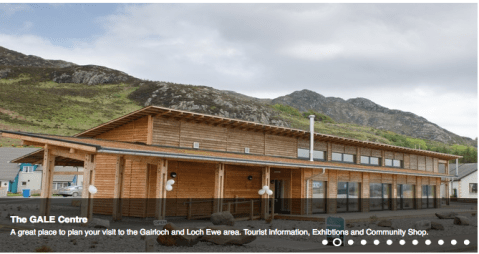
Earlier this year I was very excited to be invited to exhibit some art at the gorgeous GALE Centre centre in Gairloch. GALE stands for Gairloch and Loch Ewe Action Forum. This is a community run project which helps to support a wide range of local projects and activities and which runs an absolutely lovely information centre pictured below:
Photo curtesy of Gairloch and Loch Ewe Action Forum
The GALE centre overlooks the stunning Strath Bay and offers visitor information, regular craft and produce markets, a lovely wee craft shop and teas, coffees, soups and light meals and totally delicious cakes!
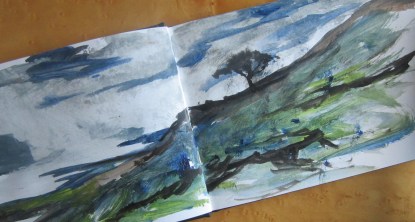
A sketch of Loch Maree
They also try and feature local artists with a small exhibition space set aside each month and in September the featured artist is me. It’s been an exhausting few weeks trying to get everything ready, but I’m so glad that I managed to get my work up and in place. The only problem is, that people might be too busy admiring the view to look at my work!
Huge thanks to Sam and to Rose who helped me set up the exhibition. I’ll look forward to seeing you at the end of the month.
my work at the GALE Centre
My work at the GALE Centre
My work will be at the GALE Centre, Gairloch until 1st of October, 2017
So the block seems to be over, which is just as well as I have several deadlines coming up in the next few weeks. I’m not sure what finally worked for me, but I think going back to basics helped.
I mentioned that I had been following Roisin O’Farrell’s blog and her words of wisdom have certainly helped, but so did watching several other artists on You Tube. There is so much support online now, much more than when I first went back to painting again five years ago.
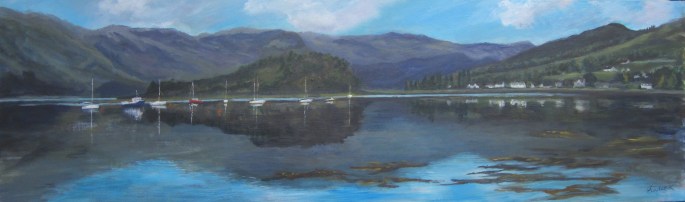
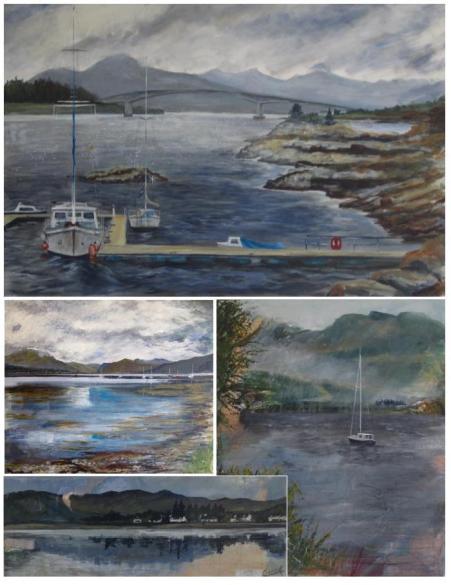
It was Roisin that got me started though. One of the things that she suggests is ‘learn your craft’ as an artist. So I lined up my paintings, ones that I had done a few months ago and the ones that I couldn’t seem to connect with now and tried to work out what I thought wasn’t working. I’m quite an intuative artist and I think that some of my paintings were working quite well, like the one below, which is a painting I did of Loch Ewe, back in the Spring
I was quite pleased with this one, but other work just seemed flat, colourless and lacking depth. I’ve had a look to see if I had any images of that work, but I don’t seem to have kept any. Anyway, I decided that maybe I should go back to basics. So I started with atmospheric perspective as that seemed to be working quite well in some of my work from the Spring, but not so much in others.
Atmospheric perspective is when an artist uses colour to simulate changes effected by the atmosphere on the colours of things seen in the distance of a painting. I decided that I was using too much colour and too much detail in background of the painting that I was working on. So I reworked it. I simplified my pallette and kept the stronger ‘saturated’ colours and detail for the foreground, and made the colours in the background more muted. This helped bring out the island, so that it was clearly defined – something that hadn’t been working before as the island and the background had been too close in tone.
I also added stronger, more saturated colour in the foreground and included more details on the boats and in the seaweed and the ripples on the water – though I’m not sure how clearly that can be seen in the photograph
The finished painting is below:
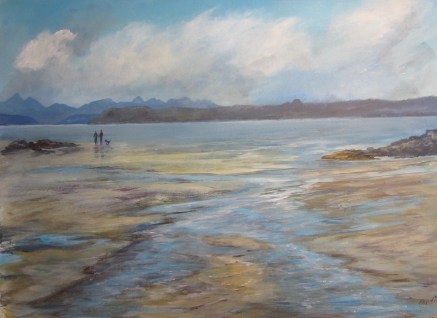
I finished this painting last week and since then I have been working on another piece, also focussing on atmospheric perspective, foreground details and varying levels of saturation.
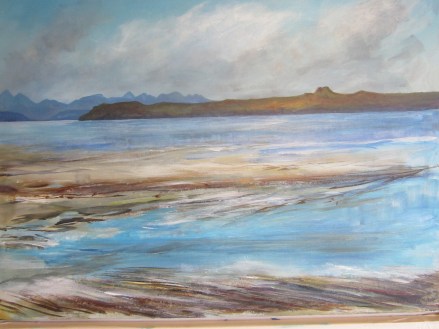
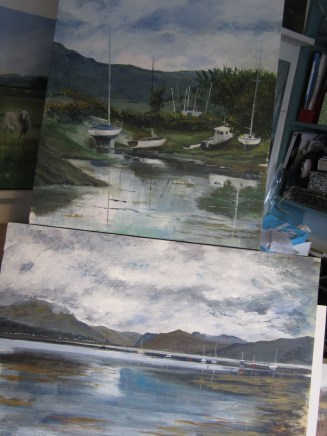
This piece was only half-finished, but I felt that the background was dominating the painting too much, luckily I did manage to find a photo of that stage of the painting, which I’ve included below. This is a view of Sand Beach in Applecross.
As you can see in the top painting, the island in the background is dominating the painting and there isn’t really and depth to the scene. I changed that by reducing the size of the island and muting or desaturating the colour. I’ve also made other changes, altering the persective of the water in the foreground so that it (hopefully) leads the viewer’s gaze into the painting, I’ve also added detail and stronger more saturated colour to the foreground and included a couple (and their dog) enjoying the view
I think that I’ve learned or maybe relearned quite a lot in these two paintings, certainly I have food for thought and something to build on in my next few pieces of work.
Something else that Roisin mentioned, was that the more paintings you produce as an artist the less you worry about each one. That really resonated with me, because I felt as if there was so much riding on each piece being prefect, but, her comments helped remind me that I’ll never achieve perfection as an artist, it’s not possible, I can only strive to produce something that I’m happy enough with and then take what I’ve learned from my latest painting and try to apply that in my next.
Meanwhile, these two paintings will be on display at Lochcarron Gallery for the next few weeks and I have more work to do for an exhibition in Gairloch next week – more about that in a day or two.
A long time since I posted. But after a flurry of creativity that lasted several months, I’ve been totally and utterly blocked. I HATED everything that I did, from sketches to paintings to, well, just about everything else.
All my usual go-to creative jumpstarts failed me and I found myself listless, unable to sleep or to concentrate or relax. I don’t think I realised how much of a safety valve my art has been for me until it just wasn’t there anymore.
I spent a lot of time in my garden. I’m redesigning part of it, and, as my husband pointed out, that’s quite creative. But it’s not the same.
I did a lot of the usual stuff to try and reconnect, try and get back into the studio, but I just ended up watching endless videos on YouTube and dusting shelves and washing brushes.
Finally I found the website of Roisin O’Farrell and, so far at least, watching her videos, which offer advice to the artist on everything from creativity to pricing and her warmth and creativity are working for me. I’ve actually started sketching again and working on some bigger pieces, so thanks Roisin
some sketches
some sketches
some sketches
Meanwhile, here’s a question for anyone who cares to comment, how do you deal with creative block? What helped you? How did you deal with that feeling that you hate everything you make or paint? Any advice is appreciated.
Meanwhile I have a small exhibition coming up soon, more about that in the next week or so, as long as I keep painting that is!
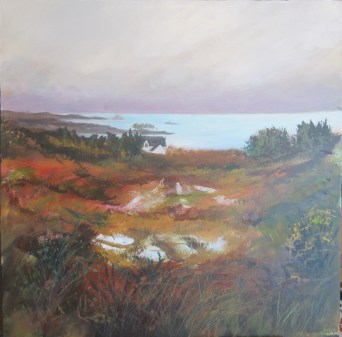
For the last couple of months I’ve been focussing on creating some new work for Lochcarron Gallery for Skyeworks Gallery and for a number of exhibitions. My latest work can be viewed on my Gallery page
I’ve also been painting some “Trompe L’oeil” objects. Decorating and reclaiming something that might otherwise have had no value, that might have been overlooked or thrown away. These are very different from my landscape painting in many ways. When I paint landscapes, I try to capture mood, light, tone and a general feeling of the day. When I paint Trompe L’oeil, it is all about the challenge of painting something that will make someone look twice at an object, surprise them and make them smile. It’s all about trying to paint as realistically as possible. My attempts at this can been seen below with my cat chair and fish tray:
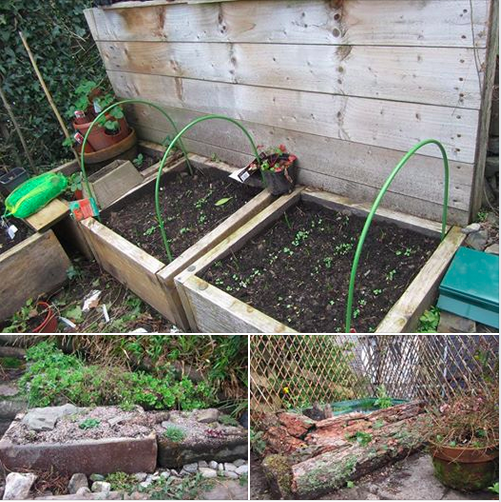
I have also been doing some gardening. April is a perfect time to work on the garden, the weather is not too hot (or cold) and there are no midges yet, always a bonus on the West Coast.
So my lettuces, potatoes, soft fruits, peas, beans, mange tout, carrots, spinach, broccoli and onions are all planted and everything else has been given a good weeding. This year, we’ve also put in a small pond – which we managed to fill with just heavy rain last week! Hopefully the garden will provide lots of inspiration for sketching and painting later in the year
As it’s February it seems fitting that I’ve just fallen in love. In my case it’s with a brand new (to me) method of printmaking, known as Collagraph.
Collagraph was first named as such in the late 1950s by artist Glen Alps and recently it seems to have become a very popular method of printmaking as the basic materials are easy to obtain and are not terribly expensive and it can produce some wonderful results.
As an introduction to collagraph, we were lucky enough at Lochcarron Gallery to be able to host 2 day-long workshops with artist printmaker Suzie MacKenzie. I first came across Suzie’s work at the Nairn Open Exhibition in 2016, where she won First Prize for her print ‘The estuary, summer evening’ and loved it. So I was very pleased when she agreed to exhibit at the gallery and even more delighted when she agreed to run a workshop for us.
Suzie has a very interesting and detailed blog on the collagraph method at Jackson’s Art, so I made sure to read that before the first workshop. There was a very thorough explaination and lots of hints and tips.
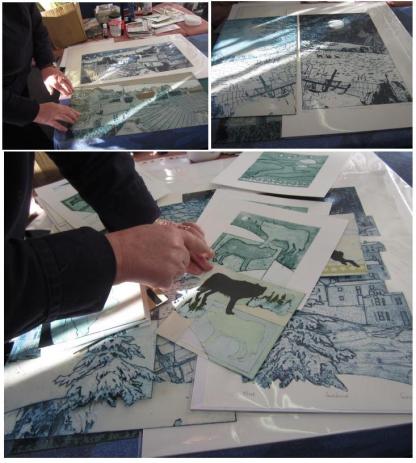
The first thing she did at the workshop was show us some of her art, and, as you can see from the images below, the plates are as beautiful as the prints themselves and very tactile too:
Collagraphs and prints by Suzie MacKenzie
After reading Suzie’s blog I had set aside some sketches that I thought might make good prints. I took photos of several sketches and then uploaded them to my computer, I changed the photos from colour to black and white ‘tonal’ photographs and, flipped them so that they were backwards or mirror images and then printed them out. It was then very easy to trace directly onto the card which would become my printing plate for each image.
The card that we were using was mountboard, offcuts left over from framing and the print technique was intaglio rather than relief. The aim is to create a variety of textures on the card, which would hold the ink during the printing process. Though Suzie also showed us some collagraphs that she had printed using the relief method and I definitely have plans to give that a try in the near future.
Suzie suggested using carbon paper to transfer the image from the reversed printout, tracing along the lines of the printed out drawing. The photographs above show the original sketches and the copied, reversed, black and white images.
The next step was to try and recreate the image taken from my original drawings. The photos above show the three plates that I created.
The first and second images show a combination of markmaking. On my first two plates I used stickyback plastic, glue, a selection of different papers and various tools to make cuts and lines in the card and to peel back sections of the surface layer of the card. Tools included an exacto knife, some embossing tools and even a biro to make the marks.
The third plate I kept very simple, using only drawn lines. For this plate I didn’t glue any paper or card to the surface, though I did peal back the surface in some areas and used PVA glue to draw some clouds and to highlight the house which I had drawn on the plate and which I wanted to leave white.
When the plates were ready I painted them with a mix of PVA and water, which was approximately the constistancy of double cream. Then, when the glue was dry the plates were sealed with a coat of spray polyurethane varnish.
The next step was to ink the plates. This was done using an oil based printing ink. Once the ink was applied the plate was wiped using scrim and newspaper and the plate was placed the bed of a printing press and printed on pre-dampened paper.
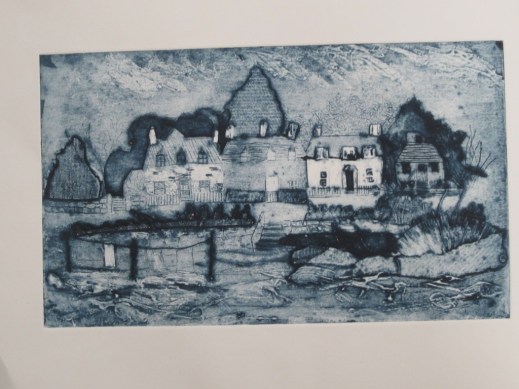
The photos above show the prints that were produced from my plates. The colour was added seperately using inks and Chine-collé (a method of applying a light-weight paper to the final print, which I will cover in more detail in a future blog).
plate 1 – the full process from original sketch to first final print
I was pretty pleased with my first print, many of my marks had come out clearly and the places that I wanted to remain lighter had indeed stayed lighter. I did over-clean the plate in some areas and I think that some of the marks could have been deeper. But all in all, not a bad first effort for a new technique.
The second plate (above) was much more experimental. I used a variety of mark making techniques and applied colour using inks (in the top print), which were applied to the surface of the paper and Chine-collé (in the bottom print) whereby paper is placed over the plate and fuses to the print during the printing process.
The third plate was less successful. Whilst some of the marks were effective, some were less so and when applying the Chine-collé i used too much glue, which ended up sticking the paper to the plate and damaging both the print and the plate itself. But, while the print itself was not a complete success, I learned a lot in processing this plate, about markmaking and about having a delicate touch and the right glue for Chine-collé (photomount glue or carefully applied glue stick and not PVA!)
However, despite a few setbacks and a steep learning curve I enjoyed every part of the process. I’m now a total convert to Collagraph printmaking and have already started another plate for printing soon. I’ll keep you posted on my progress.
My first ever collagraph print!
Thanks so much to Suzie for the encouragement and the inspiration. Please do check out her website for more information about her and her art.
I’ve been at Lochcarron Gallery again today. It’s quiet compared to the Summer months, but that gives me time to catch up on paperwork, website admin and reveiwing some of the sketches that I’ve done over the past few months.
It’s been a real learning experience, working alongside two artists, whom I admire greatly, Mairi Young and Aileen Grant
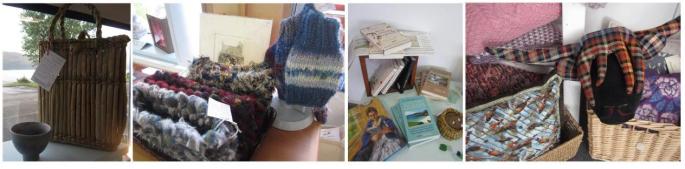
Our aim this year was to showcase contemporary arts and crafts in a bright and airy gallery space. We sourced a number of artists and makers locally and from all over Scotland and have included them in the gallery.
A selection of work by several wonderful makers, and some books too!
We also started selling books, thanks to making the aquaintance of author Graeme MacRae Burnet Graeme’s local connections led him to pop into the gallery, early last year and we took a couple of copies of “His Bloody Project” just to see how it would do. The rest, as they say, is History and it was great to meet Graeme and hear him speak, as we organised a talk here in the gallery as part of last year’s open studio project.
It’s been great to be able to be involved in the classes that we have run from the gallery, even if I haven’t been able to attend them all. I’ve still been inspired to see the work produced by the students who did take part in workshops run by, Jonathan Shearer,Sarah LongleySteven Proudfoot and Aileen Grant
The gallery has more workshops planned, over the next few months and I might even manage to run one myself!
We’ve been really lucky in our first year, with lots of support from locals and visitors, including those who are visiting the Highlands for the first time, thanks to the North Coast 500 project, which has attracted much attention and enthusiasm.
It’s been really great too, to have my work showcased alongside some wonderful artists and makers and that’s encouraged me to try new things
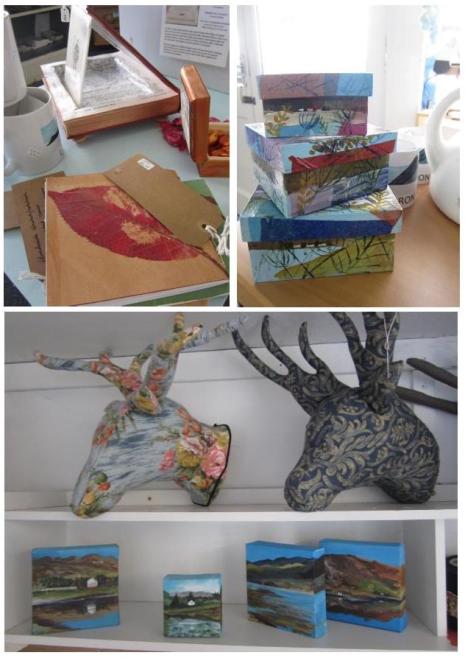
My work, book art, handmade books, painted boxes and “shelfies” shown alongside the textile art of Sue Colbourne
One of the aims of the gallery has been to have several exhibitions throughout the year, with different featured artists each time. The programme for 2017 is being drawn up at the moment, but we already have some very exiting new artists joining us this year as well as many of our favourites from last year.
Our first new exhibition will be before Easter, but in the meantime we have a great selection of work, including new pieces by me and Aileen, alongside Mairi’s glorious knits and makes.
A selection of my current work at Lochcarron Gallery
My name is Cindie Reiter and I am a landscape and decorative artist based on the West coast of Scotland.
2016 was a very busy year for me. I co-founded Lochcarron Gallery which aims to showcase comtemporary arts and crafts. It’s been a wonderful experience to work with two other very creative women and the other artists who have exhibited at the gallery.
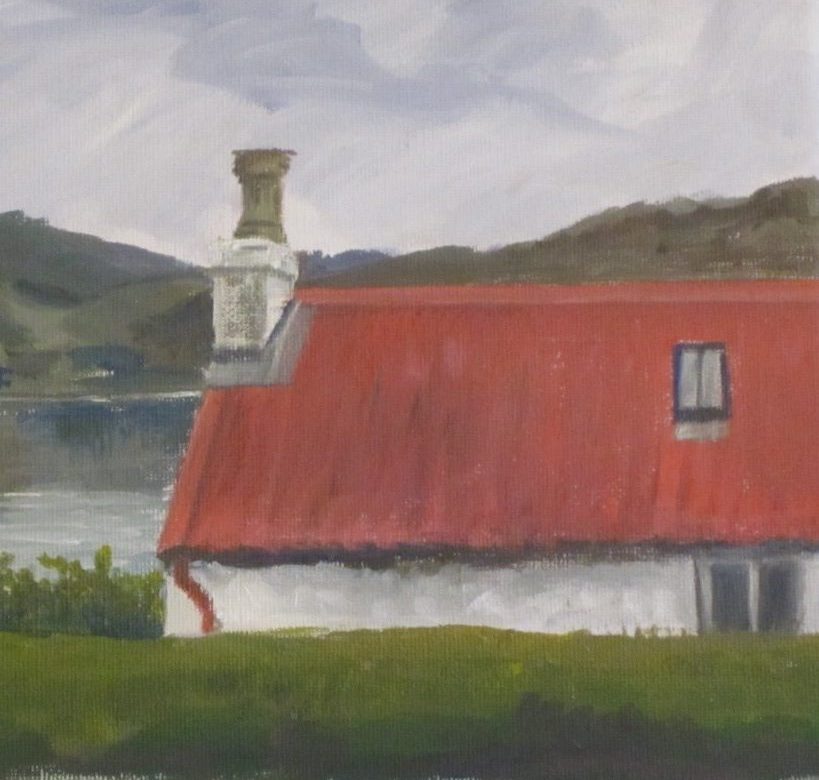
I’ve had my work showcased by other galleries and have taken part in several exhibitions. I painted outside more ‘en plein air’ and experimented with other mediums, made things from old books, recycling them into objet d’art and continued to develop my decorative work by painting trompe l’oeil on chairs and boxes. I’ve painted pots, boxes and bothies, launched a range of ‘shelfies’ – wee paintings of local landscapes, which can be hung on a wall or popped on a shelf. A selection of my work can be seen in the photo above.
I’ve attended some great workshops and met and been inspired by some lovely, creative and talented people.
January is always a little quieter for me, a time for planning ahead to the coming year. I already have two exhibitions planned and I thought this would be a good time to spend some time setting up a space that brings together all my social media sites and share a little more about me and my creative journey. Do come and say hello.








 Cindie Reiter Fine Art